 Module 4 Create 4 = Key Messages for Parents – March 1 2026
Importance of Art & Play in Early Childhood Development – Information Sheet
For Parents – Art is not an “Extra” Activity
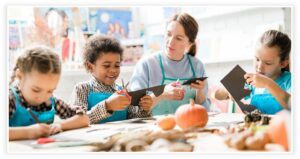
In early childhood education, art is not about getting the best picture. It is about the experience of creating something. When children paint, draw, sculpt, or build, they gain skills that stimulate their future learning and academic skills. Art has many positive influences on childhood development, such as –
-
Art Improves Cognitive Skills
Young children learn to:
- Experiment
- Explore
- Make decisions
- Solve problems
- Plan and carry out a plan
- Think in a non conventional way
Art activities encourage children to think in a flexible way which is the most useful and the most important way of thinking in a non conventional way. Thinking is needed in a wide range of forms, from reading, math, or science. Developmental research by Jean Piaget says that young children learn best when they learn by doing and by using their hands. Art does exactly that. It provides the opportunity for imagination, problem solving and develop cognitive behaviors.
-
Art Improves Physical Skills
Art provides children with the opportunity to develop the small muscles of their hands and fingers. Such activities as:
- Cutting
- Drawing
- Painting
- Working with clay
- Molding clay
Art builds the foundation for children to perform future academic tasks like writing.
-
Art Improves Communication Skills
When children talk about their artwork, they:
- Use more words
- Tell stories
- Express ideas and feelings
- Gain confidence in speaking
Art creates a lot of opportunities for conversations. Conversations with children, with educators and with family.
Research shows that creative experiences strengthen:
- Attention and focus
- Memory
- Critical thinking
- Motivation to learn
Art does not take away from academics — it strengthens the foundation for academic growth.
A Message for Families
By supporting art and play, we are nurturing:
- Curious thinkers
- Confident communicators
- Creative problem-solvers
- Emotionally healthy children
Art helps children make sense of their world — and that is the heart of education.
References
Piaget, J. (1952). The origins of intelligence in children. International Universities Press.
Vygotsky, L. S. (1978). Mind in society: The development of higher psychological processes. Harvard University Press.