Magazine: Teaching Young Children, National Association for the Education of Young Children (NAEYC)
 The Power of Play: How Kids Learn by Having Fun and Exploring
When you step into an early childhood classroom, you can practically feel the energy there. The sound of children playing, the hum of their voices making up stories, and the joy on their faces as they discover something new. For someone looking in, it could look like chaos or just play. But if you ask an effective educator, they will tell you that play isn’t a break from learning; it’s where learning starts.
Years of research proves the daily knowledge of teachers and parents all lead to the same truth: kids learn the skills they need for life when they play. It’s not just about allowing kids have fun when you protect and encourage play; it’s also about giving them the best possible start to life.
Playing Makes Brains Strong
Children learn best when they are curious, active, and feel safe. Play makes these things happen almost automatically. Kids are creating the architecture of their brains as they stack blocks, manage a pretend bakery with friends, or chase shadows across the playground.
You can see them learn the most important skills while they play. During play, children develop:
- Executive function — planning, remembering steps, staying focused
- Language and communication — negotiating roles, storytelling, asking questions
- Early math and science thinking — comparing sizes, predicting outcomes, testing ideas
- Creativity and flexible thinking — inventing scenarios, solving problems, adapting plans
- Social-emotional skills — empathy, cooperation, self-regulation
Children learn how to plan (“Let’s build a zoo for the animals!”), how to remember steps and rules, and how to stay focused on a task even when something else captures their eye. They develop language and communication by negotiating roles, making up stories, and asking questions that go in a lot of different directions. They use math and scientific skills as they compare sizes, guess what will happen next, and try out crazy ideas, such what if the tower is constructed of tubes instead of blocks? They come up with whole new world, solve problems on the fly, and change plans when things don’t go as planned, which helps their imagination and ability to think outside the box, and through it all, they’re learning how to get along with other people, how to share, take turns, and deal with their anger.
A Moment in the Classroom: The Block Area
Imagine a bunch of preschoolers playing with blocks. Someone says, “Let’s build a city for the animals!” and the floor becomes a construction site. Blocks turn into skyscrapers, cardboard tubes turn into tunnels, and bits of cloth turn into rivers and parks. People argue about where the animals should sleep, how tall the highest tower may be, and how to avoid toy trucks from getting on the roads.
In this example, children are using their imagination, making up stories, learning new vocabulary (“bridge,” “tunnel”), taking turns, solving issues, and changing their plans when the tower falls down. It may seem easy from the outside, but it’s actually a complex way of learning.
How to Be With Other People
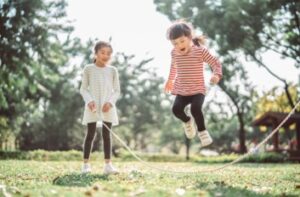
One of the best methods for children to learn is, how to deal with other people via play. In dramatic play, they talk about who will be the veterinarian and who will own the pet. They work together with imagination to come up with stories, settle arguments, and figure out how to add some thing new. In a outdoor playground, children practice taking turns on the slide, help someone who falls, or show their anger without harming someone’s feelings on the playground.
Playing with others help children learn how to talk to others, work with, and care for others. This lays the groundwork for successful relationships in childhood and in later life.
Getting in touch with the world
Children are natural adventurers. Playing gives them a chance to learn about the world in a real and hands-on way. A child learns about soil, worms, and plants while they dig in the outdoor garden. One person makes a rocket out of cardboard and wonders out loud if it could reach the moon. Another designs a map of the classroom to help them learn about space and reading.
Kids use play to try out new concepts, make sense of what they’ve been through, and relate what they’ve learned to what they already know. Their imagination runs wild.
Guided Play: Where Learning and Fun Come Together
Guided play happens in the best early childhood classrooms. It is a balance between letting children explore on their own and giving them conscious help. In this setting, teachers use open- ended resources to set the atmosphere, ask questions that make kids think more deeply, and gently build on their interests. An educator might give a group that is pretending to run a grocery shop to write lists, scales to weigh apples, or coins to tally change. The play stays focused, but the learning gets better.
Guided play isn’t about telling kids what to do all the time. It’s about watching, listening, and knowing when to step in or stay out of the way. It’s teaching, but with a child’s discovery and happiness at the centre.
Learning in Nature
Playing outside is an important part to a child’s development and learning. There are limitless chances to explore senses, take risks, and use creativity in nature. Climbing a log makes a child stronger and more sure of him or her self. Seeing clouds go past makes them curious and amazed. It takes teamwork, engineering, and determination to build a fort out of sticks and leaves.
Even when a child says I’m bored outside, it can change their lives since they make them think of new things to do and make things. There is no other classroom like nature. There are multiple things to look at and discover, all while enhancing a child’s learning.
What Do Kids Say About Playing
If you ask children why play is important, they’ll give you replies that get right to the point:
- I like building things because I can make them the way I
- Having fun with my friends makes me
- I learn new things when I do
Children sometimes know what adults sometimes forget: learning is most effective when it is fun.
Three Easy Ways to Help Play – Encourage young children to:
Come up with things to do using things like shells, fabric, or cardboard tubes.
Pay attention to what interests them and provide them fresh questions or things to think about to help them come up with more ideas. Make sure that long periods of playtime are safe. That’s when the most learning takes place.
Playing is not a luxury, it is the real work of childhood. Children play at any time of the day – it is the foundation of their learning.
Play behaviors of the child can be observed with social interaction, cooperation, problem- solving and in the child’s creativity. They discover who they are, what they can do, and how they fit into the world via play. Play can help them become more confident, strong, creative, and happy, which are all things that will help them for the rest of their lives.
The Right to Play and Rest
In the eyes of a child, play is a central part of childhood, a way to learn, develop, make friends, and emotionally express themselves. Rights like legal rights are much more difficult for children to understand. But the right to play is geared to a child’s happiness.
United Nations Article 31, The Convention of the Rights of a Child is a recognition of the importance of play for children’s development and that play is a right, not a privilege. For adults, play can be any leisure time, riding a bike, going swimming, surfing, travel or in experience of an enjoyment outcome that brings happiness and pleasure. Children value and experience play, joy, and most importantly, freedom to be a child. The same thing applies to us as adults: rest when you can and enjoy life with leisure time (play) when you can, and when in good health.
The answer is simple – let kids play if we want them to grow up to be smart, kind, and curious adults.